
Comparison of All Exness Account Types
Select the perfect Exness account type. Compare Standard, Pro, and Raw Spread accounts with detailed features and requirements.
Exness Account Types Explained
Exness offers several account formats that differ mainly in pricing structure, entry requirements, and how trades are executed. The differences are not just technical — they directly affect how much you pay per trade and how strategies perform over time.
There are three commonly used options: Standard, Pro, and Raw Spread. Each one fits a different approach. Some traders prefer simplicity with no commission, others focus on tighter spreads even if it means paying a fixed fee per lot.
- Experience level and trading habits
- How often you open positions
- Preference for spreads vs commissions
- Deposit size and risk tolerance
- Execution speed requirements
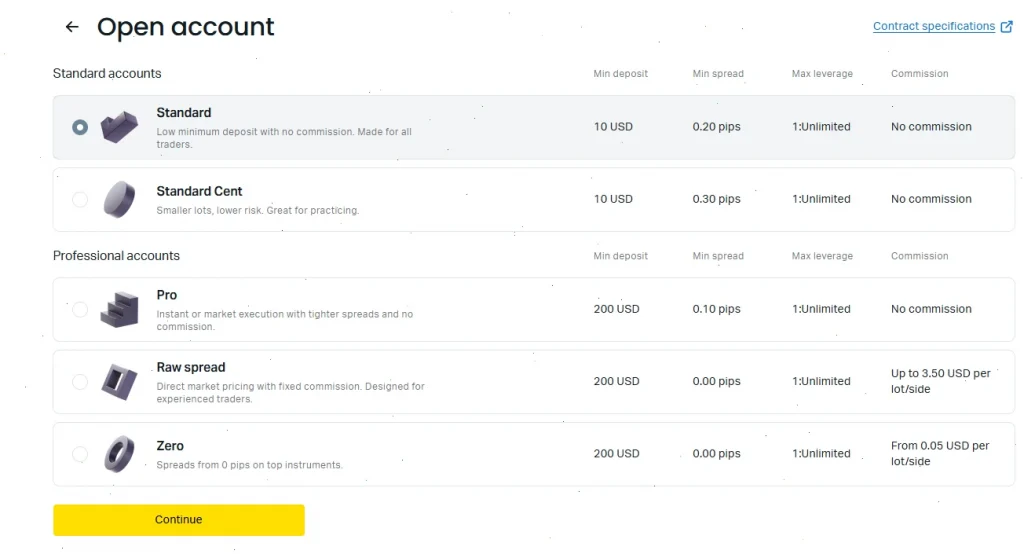
In practice, many start with a simpler account to understand platform behavior, then move to more cost-sensitive setups once consistency improves.
| Account Type | Minimum Deposit | Spreads From | Commission | Typical Use |
|---|---|---|---|---|
| Standard | $10 | 0.3 pips | None | Getting started |
| Pro | $200 | 0.1 pips | None | Regular trading |
| Raw Spread | $200 | 0.0 pips | $3.5/lot | High-frequency trading |
Standard Account: Simple Setup with Flexible Conditions
The Standard account is often where traders begin. It doesn’t include commissions, which makes cost calculation straightforward — the spread is the main expense.
Spreads typically start around 0.3 pips on major pairs. In calm market conditions, they stay relatively stable, though they can widen during volatility. That’s normal across most brokers.
Key characteristics
The entry requirement is low — around $10 — which makes it accessible without committing large capital. You also get access to a wide range of instruments, including currencies, metals, and energy markets.
Execution is market-based, usually under 0.3 seconds. For most manual traders, that’s fast enough. Automated strategies also work without restrictions, including scalping or hedging.
How it feels in practice
This type of account works well for testing strategies or trading smaller volumes. Since there’s no commission, it’s easier to track performance without overthinking fee structures.
Pro Account: Lower Spreads Without Extra Fees
The Pro account sits somewhere in the middle. It keeps the no-commission model but offers tighter spreads — starting from about 0.1 pips.
To access it, a higher deposit is required (around $200). That shift alone already filters for traders who operate with more consistency or slightly larger position sizes.
What changes compared to Standard
Execution tends to be more stable, especially during fast-moving markets. Many traders notice fewer sudden spread spikes compared to basic accounts, though this still depends on overall liquidity.
Order handling is slightly more refined — useful if you rely on precise entries or trade around news events.
Features worth noting
- More stable spreads in active sessions
- Access to advanced order types
- Support for automated and manual trading
- Same platforms (MT4 and MT5)
In real use, this account often becomes the default once trading moves beyond the experimental stage.
Raw Spread Account: Cost Control for Active Traders
The Raw Spread account is structured differently. Instead of wider spreads, it offers near-zero spreads (from 0.0 pips), but adds a fixed commission — about $3.5 per lot.
At first glance, it might seem more complex. But for traders opening multiple positions daily, the overall cost can actually be lower and more predictable.
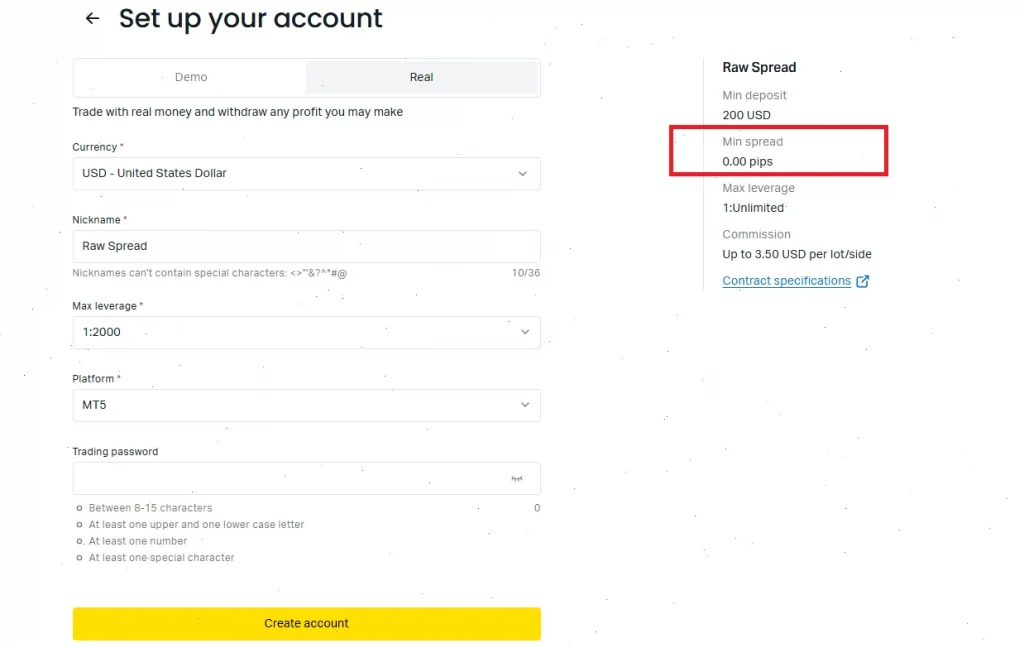
Execution environment
Orders are processed using direct market access principles. That means pricing comes from liquidity providers without internal intervention. Execution speed is typically around 0.1 seconds under normal conditions.
This setup is often chosen by scalpers or algorithmic traders, where even small differences in spread can affect long-term results.
| Feature | Standard | Pro | Raw Spread |
|---|---|---|---|
| EUR/USD Spread | 0.3 pips | 0.1 pips | 0.0 pips |
| Commission | None | None | $3.5/lot |
| Min Deposit | $10 | $200 | $200 |
| Execution | Market | Market | DMA/STP |
Account Setup and Verification
Opening an account is done online. The process includes registration, identity confirmation, and basic security checks. Most users complete it in less than a day if documents are prepared in advance.
Verification basics
You’ll need:
- A valid ID document
- Proof of address (recent utility bill or statement)
- Email and phone confirmation
Documents should be clear and up to date. In some cases, additional checks may be required, especially for higher deposit levels.
Deposits and withdrawals
Common funding methods include:
| Method | Processing Time | Minimum Deposit | Notes |
|---|---|---|---|
| Bank Transfer | 1 business day | $10 | Stable but slower |
| Card Payment | Instant | $10 | Convenient for most users |
| E-wallets | Instant | $10 | Often fastest withdrawals |
In practice, many traders prefer e-wallets due to speed, especially when moving funds frequently.
Trading Platforms and Tools
All account types work with MetaTrader 4 and MetaTrader 5. These platforms are widely used and support both manual and automated trading.
Core functionality
You’ll find:
- Dozens of indicators and charting tools
- Expert Advisors (automated trading)
- Economic calendar and news feed
- One-click trading
Mobile experience
Mobile apps cover most desktop features. Traders often use them for monitoring positions or quick entries rather than full analysis.
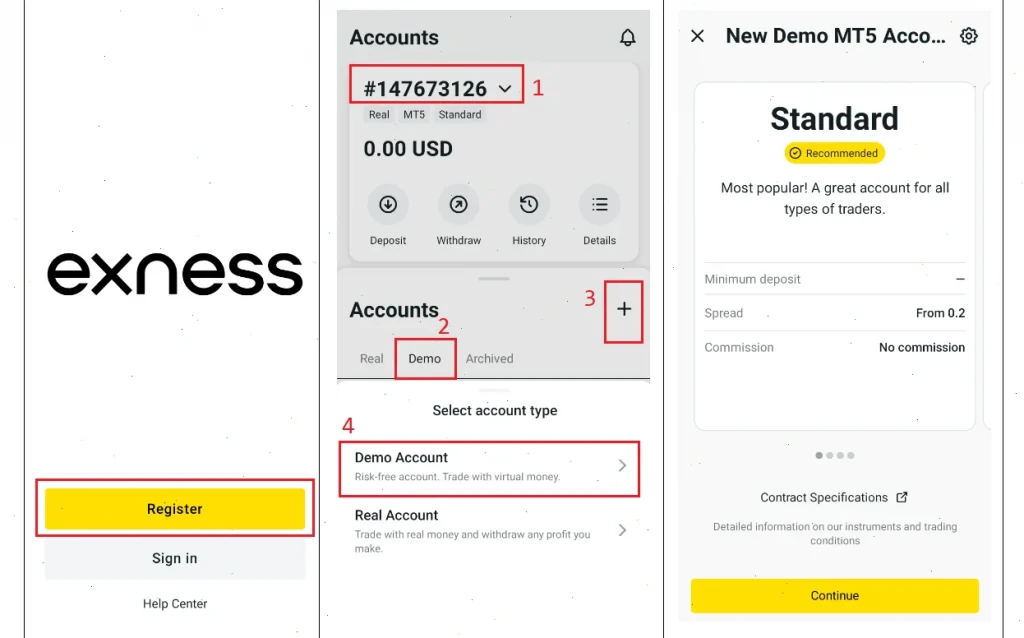
In everyday use, syncing between devices is reliable — positions and history update almost instantly.
Risk Management and Safety
Trading always involves risk, especially when leverage is used. Even with favorable spreads, losses can occur quickly in volatile conditions.
Exness includes several built-in protections:
- Negative balance protection (you can’t lose more than your deposit)
- Segregation of client funds
- Real-time margin monitoring
A stop-out level at 0% means positions are closed only when margin is fully exhausted. While this provides flexibility, it also requires careful risk control — otherwise drawdowns can become significant.
| Protection | Details | Applies To |
|---|---|---|
| Negative Balance | Full coverage | All accounts |
| Fund Segregation | Separate accounts | All accounts |
| Stop Out | 0% level | All accounts |
Choosing Between Account Types
There isn’t a universal “better” option — it depends on how you trade.
- Lower activity → Standard account often makes sense
- Regular trading → Pro offers a balance
- High-frequency strategies → Raw Spread may reduce costs
For example, if you open a few trades per week, the difference between 0.3 and 0.1 pips is small. But if you trade dozens of times per day, even a fraction of a pip becomes noticeable over time.
Many traders adjust their account type as their strategy evolves. That flexibility helps test different cost models without starting from scratch.
 FAQ
FAQ
What is the minimum deposit?
The entry level starts from around $10 for the Standard account, while other accounts typically require about $200.
Can I switch account types later?
Yes, additional accounts can be created and managed within the same profile without affecting existing trades.
Which platforms are supported?
MetaTrader 4 and MetaTrader 5 are available across desktop, web, and mobile devices.
Is swap-free trading available?
Yes, swap-free conditions can be enabled depending on account settings and eligibility.
How are funds protected?
Client funds are held separately, and negative balance protection limits potential losses to deposited amounts.