
What Is the Minimum Deposit in Exness
Open your Exness trading account with just a $10 minimum deposit. Access forex, CFDs, and premium trading tools instantly.
Exness Minimum Deposit: What to Expect in Practice
Getting started doesn’t require a large balance. A Standard account can be opened with as little as $10, which is often enough to test the platform in real conditions rather than relying on demo trading alone. For many beginners, this lower entry point makes it easier to understand how spreads, execution, and volatility actually behave.
Deposits are typically processed without noticeable delays. In most cases, funds appear in the account within seconds when using cards or digital wallets. This matters more than it sounds—especially if you’re reacting to fast-moving markets where timing can affect entry price.
Different payment routes are supported, including bank cards, online wallets, transfers, and digital assets. Many traders alternate between methods depending on speed or fees. For example, smaller deposits are often made via e-wallets due to convenience, while larger amounts may go through bank transfers for record-keeping.
| Account Type | Minimum Deposit | Spreads From | Leverage Up To |
|---|---|---|---|
| Standard | $10 | 0.3 pips | 1:2000 |
| Pro | $200 | 0.1 pips | 1:2000 |
| Raw Spread | $200 | 0.0 pips | 1:2000 |
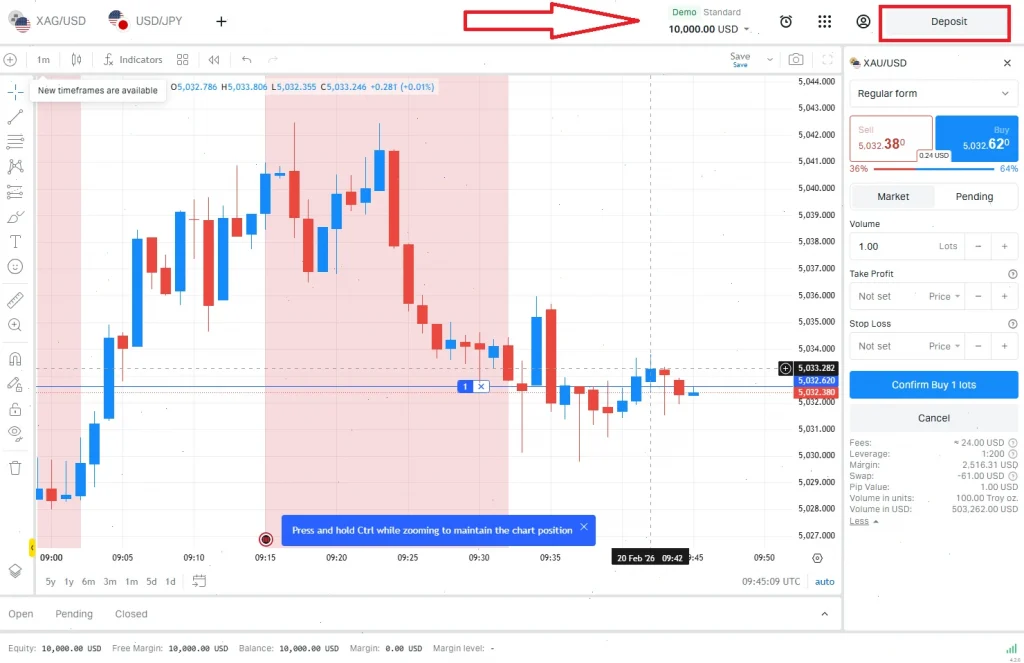
Account Types and What You Actually Get
Standard Account
The Standard account is usually where most people begin. With a $10 deposit, you get access to over 120 instruments—currencies, indices, commodities. Spreads start around 0.3 pips, though they tend to widen slightly during volatile sessions.
In practice, this account works well for testing strategies or trading smaller positions. It also supports automated trading, so using Expert Advisors isn’t restricted even at lower balances.
Pro and Raw Spread Accounts
For those trading more actively, the Pro and Raw Spread accounts require at least $200. The difference shows up mostly in pricing and execution.
Raw Spread accounts can display spreads from 0.0 pips, but there’s a fixed commission per trade. This setup is often preferred by scalpers who rely on tight spreads and quick execution. The Pro account sits somewhere in between—lower spreads than Standard, but without a separate commission in most cases.
Deposit Methods and Processing Speed
Funding an account is fairly flexible. Card payments and e-wallets are usually the fastest, often completed instantly. That’s why many traders use them for regular deposits or when they need to react quickly.
Bank transfers take longer—typically between 1 and 3 business days. International transfers can stretch further depending on intermediary banks. This makes them less suitable for urgent funding but still useful for larger amounts.
Cryptocurrency deposits are also available. These depend on network confirmations, so timing can vary. In most cases, it takes somewhere between 10 and 30 minutes.
- Card payments (Visa, Mastercard) – usually instant
- E-wallets – quick processing, often with minimal fees
- Cryptocurrency – depends on blockchain confirmations
- Bank transfers – slower but commonly used for higher amounts
- Automatic currency conversion during deposit
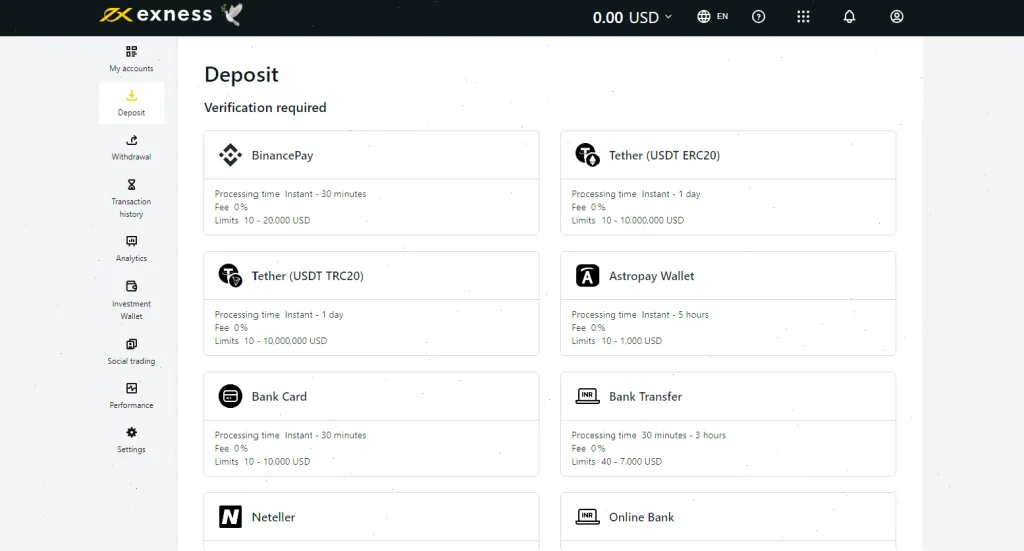
How Deposits Work Step by Step
Verification
Before making your first deposit, identity verification is required. Typically, this involves uploading an ID and a document confirming your address. Most accounts are verified within a day, though delays can happen if documents are unclear.
Making a Deposit
The process itself is straightforward and doesn’t take long:
- Log in to your account dashboard
- Open the deposit section
- Select a payment method
- Enter the amount (starting from $10)
- Confirm the transaction
Once completed, funds are usually available immediately if the chosen method supports instant processing.
Currencies and Conversion Details
Accounts can be opened in several base currencies, most commonly USD or EUR. The minimum deposit remains roughly equivalent across currencies (around 10 units), so the entry barrier stays low regardless of choice.
Conversion happens automatically when depositing in a different currency. Rates are updated in real time, which helps avoid large discrepancies, although small differences can still appear depending on the provider.
Some traders open multiple accounts in different currencies to reduce conversion costs over time. This becomes more relevant when trading instruments tied to specific currencies.
| Base Currency | Minimum Deposit | Common Pairs | Conversion Fee |
|---|---|---|---|
| USD | $10 | EUR/USD, GBP/USD | 0% |
| EUR | €10 | EUR/GBP, EUR/JPY | 0% |
Trading Access After Funding
MetaTrader Platforms
Once the deposit is complete, trading can begin immediately through MetaTrader 4 or MetaTrader 5. MT4 remains widely used for forex trading, while MT5 adds more order types and expanded analytics.
Execution speed is typically under a fraction of a second, which becomes noticeable when placing market orders during active sessions.
Web Terminal
The browser-based terminal works without installation. It’s often used on mobile devices or when switching between different systems. Features like one-click trading and built-in indicators are available, though experienced users may still prefer desktop platforms for more control.
Withdrawals: Timing and Limits
Withdrawals generally follow the same route as deposits due to compliance rules. This is standard practice and helps reduce fraud risks.
In many cases, there’s no strict minimum withdrawal, especially for digital wallets. Bank transfers may require at least $10, depending on the method.
Processing times vary:
| Method | Processing Time | Minimum Amount | Fees |
|---|---|---|---|
| E-wallet | Instant | $1 | Free |
| Bank Card | 1–3 days | $1 | Free |
| Bank Transfer | 1–5 days | $10 | Free |
| Cryptocurrency | Network-based | $1 | Network fees |
Risk Controls and Account Safety
Negative Balance Protection
Accounts include automatic negative balance protection. In simple terms, losses cannot exceed the deposited amount. This becomes particularly important during sharp market moves, where prices can gap unexpectedly.
Security Measures
Funds are stored separately from operational accounts, which is a standard safety measure across regulated brokers. Encryption protocols protect transactions, and optional two-factor authentication adds another layer of security.
Even with these protections, trading itself carries risk. High leverage (up to 1:2000) can amplify both profits and losses, so position sizing and risk management are critical in real trading conditions.
| Security Feature | Description |
|---|---|
| Encryption | Secure data transmission |
| 2FA | Extra login verification |
| Segregated Funds | Client funds stored separately |
| Audits | Regular external checks |
 FAQ
FAQ
What is the minimum deposit?
The entry point starts from $10 for a Standard account.
How fast are deposits processed?
Most methods, especially cards and e-wallets, are completed instantly.
Are there withdrawal limits?
Many methods allow withdrawals from as little as $1, though bank transfers may require around $10.
Which platforms are available?
MetaTrader 4, MetaTrader 5, and a browser-based terminal are accessible after funding the account.
Is trading risk-free?
No. While protections exist, trading with leverage involves risk, and losses can occur quickly if not managed properly.